

Rave Reviews
A time capsule of 1992 rave zine mentions
Among this week’s music selections: We’re digging into the origin of the word “rave” along with selected sounds inspired by a Tampa, FL rave-culture zine published between 1992-1994; and a nostalgic, mid-90s dance-music re-issue that brought back memories, and more! Put on your dancing shoes, and don’t forget to stay hydrated. We’re taking a trip back in time.
On the origin of the term “rave”
Over the winter, I finally got around to reading Kelefah Sanneh’s Major Labels, a personal essay hybridized with a history of popular music in the latter 20th and early 21st centuries. It was in the unread section of the bookshelf for a bit, but it’s cover was too attention-grabbing to leave for long.

It’s a wonderful survey of each genre that mingles music history with Sanneh’s own life-long love of music, spanning college radio gigs, record store jobs, and a professional writing career (NYT, et al). The prose manages to be both engaging and informative. Although some deeply read music-heads might get sidetracked pointing out things that he failed to mention, the book isn’t a completist history (nor is it intended to be), but an illustrative arc interwoven with his connections to aspects of each genre. Sanneh is an omnivorous listener who conversationally shares knowledge accrued in the pursuit of his passion. Relatable.
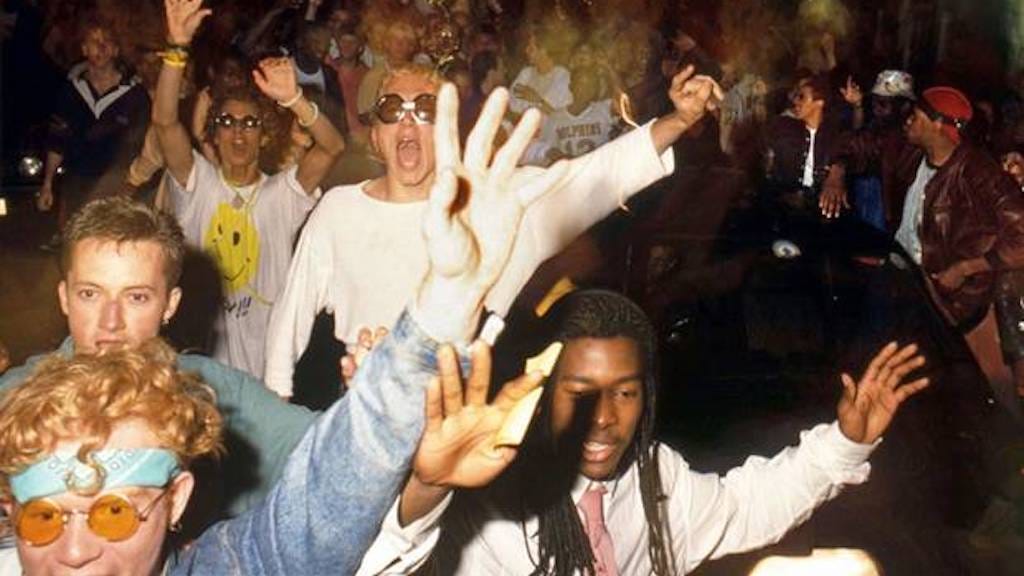
To set the stage with some historical context for this week’s rave motif, I thought it would be nice to ground ourselves with a passage about the origin of the term rave, which dates back to England in the late 1980s. It was the earliest days of the acid techno craze, and papers in the UK had started to run sensationalist headlines about the “dangerous” new subculture corrupting the nation’s youth. From Sanneh:
“For British dancers, the summer of 1988 — the summer of love, people called it — was year zero, the birth of a new culture, and the era to which all other eras would forever be compared, usually unfavorably. During the acid-house craze, partiers sometimes described what they were up to as “raving,” and in the years that followed, they began to use “rave” as a noun, a name for an outdoor party; these, often illegal, became the most influential sites for British dance music. By 1990, the British “acid” craze had given way to so-called rave culture, which was less Mediterranean in spirit and less American in sound — altogether more homegrown. The rave scene was rebellious: skeptical of the media, which had turned acid house into such a circus, and resentful of the police, who always seemed to be trying to ruin a good party. Organizers often tried to outwit the authorities by refusing to reveal a party’s location in advance; prospective partygoers might be given a number to call, or a meeting place to find, for precise directions. For many of the attendees, the late-night scavenger hunt was part of the thrill.”
So, at that pre-internet moment, the only way to really be exposed to the culture in its early days was to have contact with the UK scene, either in-person or via imported records and publications. Scenes cropped up in NYC, LA and other cities across the US, where the concepts also reintegrated a wider set of stylistic niches — all part of a gravitational, ourobouros-style exchange of music influences that is part of how club music constantly reinvents itself, but I digress...
The point being it took effort to find a rave scene in the US in the early ‘90s. There were specialist record shops that emerged, staying on top of the latest labels, exclusive singles and remixes, etc. But you had to know how to find those shops physically without Google Maps. Or you had to solve for mail order. It’s all deeply anachronistic now. But, way down in western Florida in the early 1990s there was a small scene taking shape in Tampa, FL, which was documented for a few years in a locally made zine called Trip Magazeen.
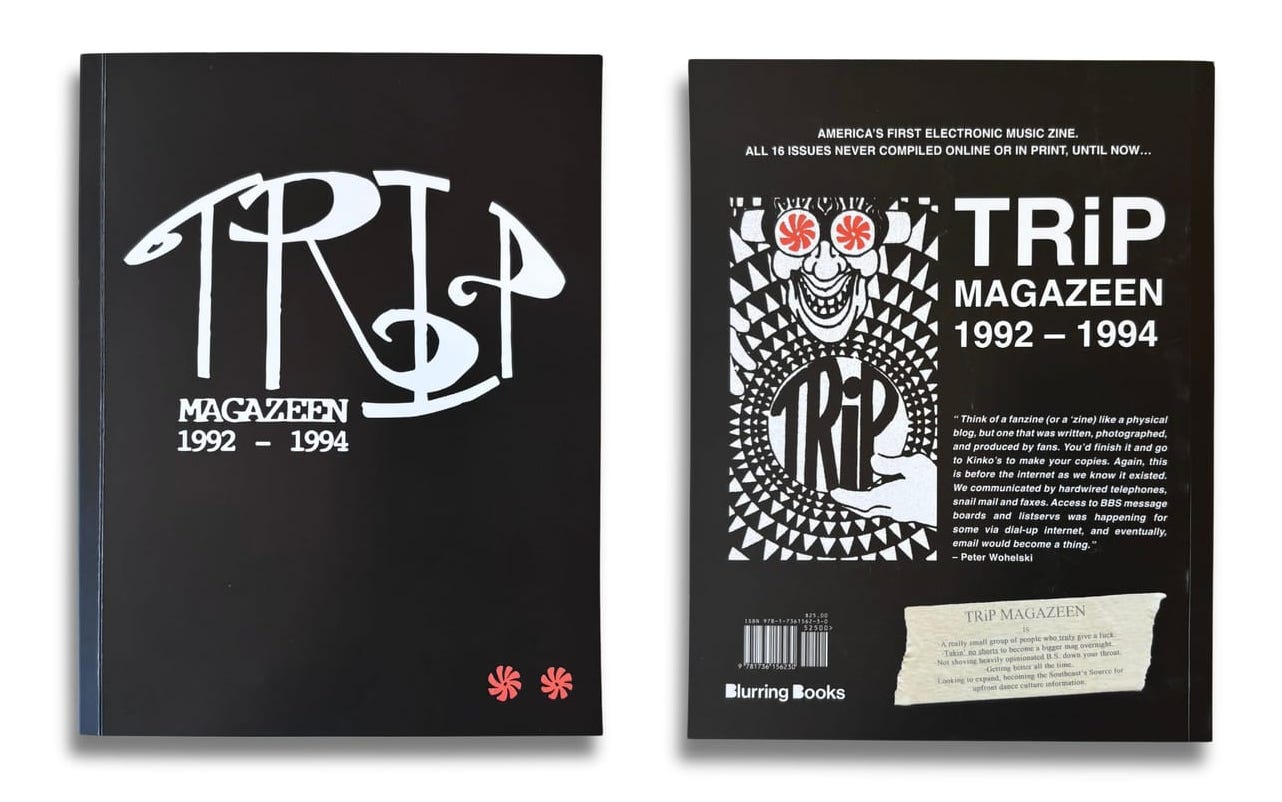
I learned more about this thanks to a recently released compilation of all 16 issues, originally published 1992-1994 by DJ Three (DJ3) and a handful of collaborators from the scene. He’d spent some time in London and got to experience the shops and parties before returning home to spread knowledge — including write-ups about different kinds of lighting effects when throwing one’s own parties, and other practical lessons, along with pages of music reviews.
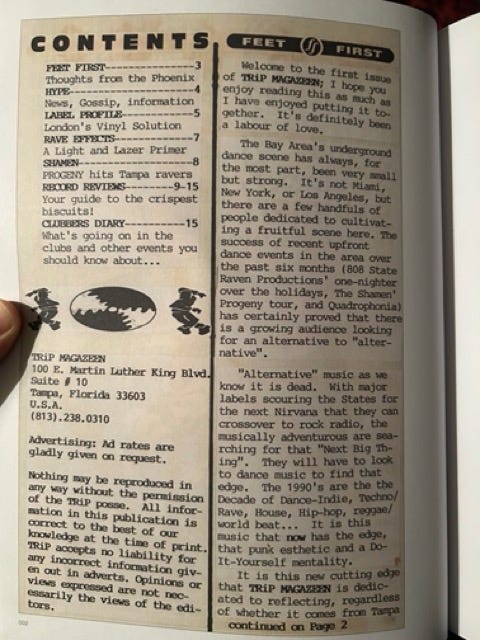
Because the Trip team were very early to the game, they got some incredible interviews with folks like Moby and Aphex Twin very early in their respective contributions to redefining the sounds of the 1990s and beyond.
Anyway, I thought it would be fun to pull together a few selections and tangents from among the first couple of issues I read because it’s quite a musical time capsule.
Prodigy - “Charly”
The band’s first single from spring of 1992, which dropped as a 12” and then later appeared on their debut LP Experience, is a perfect illustration of the early-90s raver sound. Uptempo break, crazy bass line, all peppered with samples and snippets and then suddenly a stabby breakdown. This is basically a template for the matured, mid-phase of rave sounds. You could teach a class about the influence of this song’s structure and arrangement on the genre.
Of course, the band really broke through in the US in a more mainstream way thanks to MTV playing the sinister sounds of “Firestarter” with some regularity in 1996. That’s still a total banger. Would listen to it while smashing things or setting them on fire, perhaps.
Massive Attack - Blue Lines
The fun thing about the zine’s content is that it’s really a cross-section of underground sounds and not exclusively focused on dancefloor music. Massive Attack’s 1991 trip hop masterpiece Blue Lines gets a shoutout. Here’s the extra smooth title track, which owes a sonic debt to ATCQ and Digable Planets. Chill-out room excellence.
Saint Etienne – Foxbase Alpha
I didn’t go through and count, but my initial impression is that Saint Etienne is among the most-mentioned artists in the first couple issues, followed closely by Moby. It’s neck and neck. Saint Etienne’s debut from 1991, Foxbase Alpha, is a splendid example of sampling and sequencing work drawing on the techniques of hip hop and dance music but with an expanded palette of UK influences — as evidenced by this reggae-pop cover of the Neil Young tune “Only Love Can Break Your Heart”, which isn’t necessarily emblematic of the album’s sound in total, but is magnificent in its own way. This song might end up on my summer mixtape.
Moby - “Go”
Speaking of… I know it’s not cool to like Moby, but that shouldn’t cause us to lose sight of the fact that he had some big tunes at the dawn of the ‘90s. This dancefloor-mover really packs it in — the “Go” sample is perfect, there’s a keyboard solo, a rush of spooky minor key strings, a hint of R&B diva… everything…
Bassheads - “Is There Anybody Out There”
From the zine’s original review: “With all but one sample re-recorded from its white label day this atmospheric, moody, episodic, twittering, jangling, rock-riffed, Pink Floyd sampling, Afrika Bambaataa chanted track makes you want to “just get up and dance.” A Top 10 U.K. hit.”
Wishdokta - “Evil Surrounds Us”
This tune was originally released in 1992 on a compilation called Champion Sound from “one of the U.K.’s up-and-coming hardcore techno labels” Kickin’ Records. Stick around for the Guns ‘n’ Roses-sample breakdown between this raving explosion stretched out across a sped-up break, a kick drum with a truly ominous cadence and some intense synth and programming work on top. This tune builds across a couple of phases and finds ways to get more intense as it goes. Pretty amazing work when you consider how simple their setup was compared to the average DAW-equipped producer today.
Galliano - “Jus’ Reach”
This is a smooth and funky treasure. In the UK it was released by Gilles Peterson’s label Talkin Loud, and in the US by 4th & Broadway. This is a feel-good groover. Go ahead and hug your neighbor. The zine’s reviewer didn’t like this single as much as the jazz-poetry vibes of Galliano’s LP titled In Search of the 13th Note, but in my opinion “Jus’ Reach” has aged much better than that album, sonically speaking. If you’re still reading this far in, I highly recommend you press play on this one. It’s fun.
The 30th Anniversary of Orbital’s In Sides
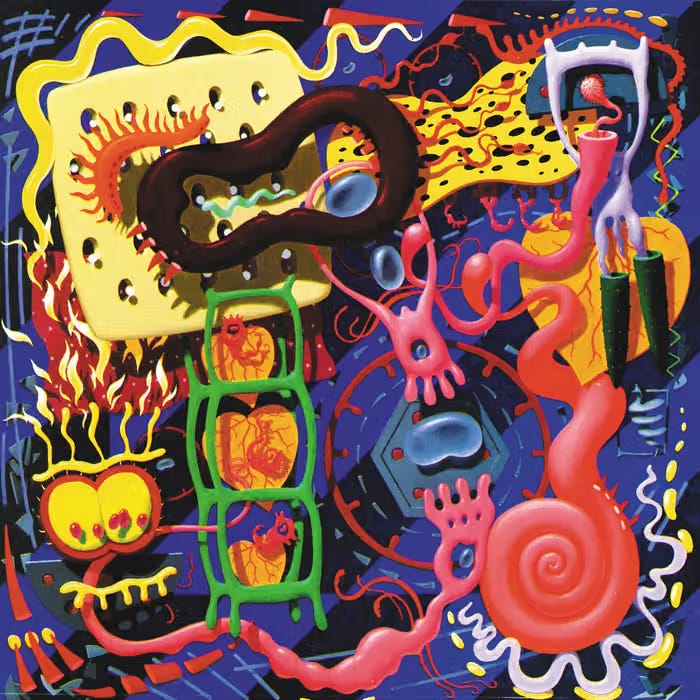
It would be wrong to say that I was “surprised” that it was the 30th anniversary of this record, but it had been many years since I’d thought about it (or listened to it), and so it did catch me off guard when it popped up in my feed with a milestone birthday re-issue. It’s like finding out how old some of your children are now. Hearing it really took me back and made me think about my own aging.
I wasn’t up on this album right away when it came out in ‘96, but it showed up in my life circa ‘98, and it really feels like a watershed album (also shout out to Aphex Twin, obv). Songs like “The Girl With the Sun in Her Head”, “The Box (Part 1)” and “The Saint” are etched deep in the folds of my brain from repeated high school listening. Related to our earlier thread: Long players like “Out There Somewhere (part 1) really show the influence of UK acid as the sound grew and evolved from its origins into the mid-90s.
Also, shout to the cover art for this album. MGMT wouldn’t have been the same, aesthetically speaking, without this album cover existing. Everything moves in cycles.
That’s all for this week. Thanks for spending some time listening with us. We’ll be back next week with something completely different. Until then, take care hiding your party from the cops (literally or metaphorically).